


Next: 5.10 Suggested Reading Up: 5. Inelasticity Previous: 5.8 Visco-elasticity and Visco-plasticity Contents
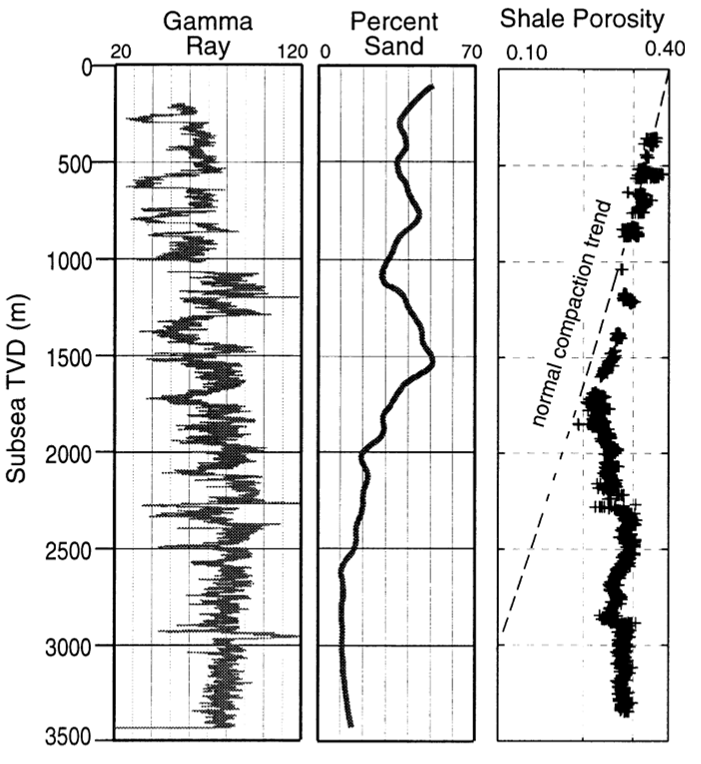
The following data set contains well-logging measurements of porosity of a mudrock as a function of depth (Eugene Island – offshore Louisiana):
 |
 = 0.465 psi/ft.
 = 0.950 psi/ft and pick the seafloor from the shallowest data point in “percent sand” plot.


 as a function of depth.
 and actual
  as a function of depth (y-axis)
Write a script that simulates a (axisymmetric) triaxial loading test (
 ) for a mudrock with the following properties:
 = 1 MPa;
 = 250 [kPa]

 = 0.25;
 = 0.05;
 = 1.15;
The initial state of stress is  = 200 kPa;
  = 0 kPa. Load the sample until the critical state.
versus . Plot the initial yield surface and the final yield surface. Is there hardening or softening?
as a function of
 . Why does it approximate an asymptotic value?
 as a function of (with in logarithmic scale). Why is there a clear change of slope?
 , up to
 kPa). Plot the stress path versus and void ratio as a function of (with in logarithmic scale). Compare the uniaxial-strain stress-path with the triaxial deviatoric loading stress path.
Equations:
Incremental elastic deformations:
Incremental plastic deformation:
![$\left[ \begin{matrix}
d\varepsilon_{p^\prime}^p \\
d\varepsilon_q^p\\
\end{...
...trix} \right]
\left[ \begin{matrix}
dp^\prime \\
dq \\
\end{matrix}\right] $](img133.svg)
where
 is the specific volume,
  , and
, and
 .
.
The incremental change of the yield surface is:
 .
.