Subsections
The file BiotCoeffExperiment.xlsx has data from a laboratory experiment on a reservoir sandstone that shows axial and radial deformations caused by alternating variations of confining stress  and pore pressure
  .
.
- a.
- Plot pressure and stresses as a function of time.
- b.
- What are the dPc/dt and dPp/dt loading rates when either confining or pore pressure are increased??
- c.
- Fit a straight line to the data to obtain a unique relationship between
 and
and
 (effective), and calculate the bulk Biot coefficient
  . Assuming isotropic elasticity and that the Poisson Ratio is 0.25, what is the Young's modulus?
- d.
- Plot together the volumetric strain with Terzaghi’s and Biot’s effective stresses.
- e.
- If permeability is k = 100 mD, the fluid is water, porosity is 0.28, and the sample length is 0.05 m with top and bottom drainage, what is the characteristic time for pore pressure diffusion
 ? How does it compare to the pressure/stress loading time? Would it be drained or undrained loading? Note: you need the diffusivity parameter for which you have to look up for properties of water.
- f.
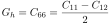
- EXTRA: Use the theory of transverse isotropic poro-elasticity to figure out the stress paths needed to measure directly
 and
and  .
.
Figure 3.1:
Variation of volumetric strain with Terzaghi's effective stress.
|
For this problem you have to use the geomechanical module of reservoir simulator CMG https://www.cmgl.ca/.
The software is available to UT Austin students here: http://pge.utexas.edu/LRC/
- a.
- Review the files CMG_Geomechanics_Tutorial.pdf and CMG_Running_InputFile.pdf.
- b.
- Change the vertical stress and well schedule as shown in the figure below (example files: Injection1.dat and Production1.dat.
Figure 3.2:
Schematic cross section of reservoir model for depletion.
|
- c.
- What is initial boundary condition in each direction? (i.e. constant stress or zero displacement).
- d.
- Plot 1 - Plot minimum principal total stress (Total stress I), vertical total stress (Total stress K), and pore pressure (Pressure) vs time. (**Note: Please remove initial data (time = 0) when you plot).
- e.
- Plot 2 - Plot minimum principal stress (y-axis) vs pore pressure (x-axis), and verify the slope of the curve is similar with
 ( is the Biot coefficient and
  is Poisson’s ratio - **Note: Please remove initial data (time = 0) when you plot pressure and stresses).
- f.
- Run the simulation again using Biot coefficient from the previous laboratory problem, repeat the question “d” using the new simulation result and plot on the same figure.
- g.
- Plot the stress path with Mohr circles for the initial (0.1 days) and final time (100 days).
- h.
- Plot the stress path in the
 space for the same period of time.
- i.
- What is the absolute minimum pressure to create a hydraulic fracture (i.e. minimum principal total stress) at the end of the simulation when bottom-hole pressure is BHP = 240 psi? Compare with the analytical solution.


![\includegraphics[scale=1.0]{.././Figures/Biot.PNG}](img73.svg)
![\includegraphics[scale=0.60]{.././Figures/ResModel_Depletion.PNG}](img74.svg)